Why the Birthday Font Feels Like a Handwritten Hug
There’s a moment in every project where the typography either clicks or it doesn’t. You’ve nailed the colors, the layout feels balanced, the imagery is spot on—but something’s missing. That’s often where a typeface like Birthday enters the picture. It’s not trying to be everything. It’s a sweet, handwritten font with a friendly personality, and sometimes that’s exactly what a design needs to land emotionally.
Birthday isn’t the kind of font you reach for when you’re building a quarterly report or drafting a legal contract. It lives in a different space entirely—the space where warmth matters more than formality, where a personal touch beats corporate polish. Think of it as the typographic equivalent of a handwritten note slipped into a gift bag. It carries intention.
A Font That Understands Occasion
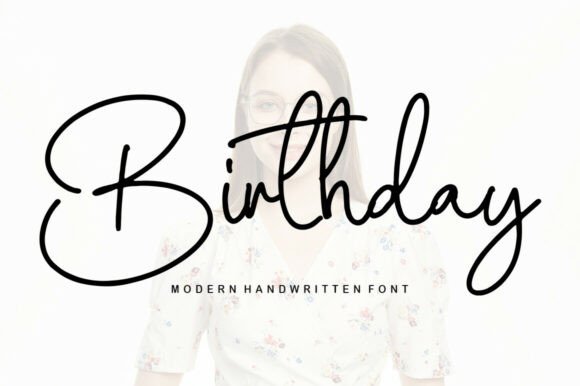
The name itself tells you a lot. Birthday leans into celebration, into moments that feel personal and a little playful. Its letterforms have that natural, slightly imperfect quality you get from actual handwriting—not so messy that it’s illegible, but loose enough to feel human. The strokes flow with a casual rhythm, the connections between letters feel organic rather than engineered.
What makes it visually appealing is that balance. It’s cute without being childish. Friendly without being saccharine. There’s a lightness to it that works beautifully when you want your design to feel approachable. The characters have enough personality to stand on their own in a headline, but they also hold together well in shorter blocks of text—phrases, taglines, invitations.
If you’ve ever spent twenty minutes browsing script fonts and handwritten fonts trying to find one that doesn’t look like it belongs on a tween’s notebook cover, you’ll appreciate what Birthday gets right. It has sophistication baked into its casualness.
Where This Font Actually Works
Let’s talk specifics, because a font’s value is always tied to context. Here’s where Birthday tends to shine:
Wedding invitations and event stationery. This is the obvious one, and for good reason. Birthday’s handwritten quality gives invitations a personal, crafted feel that digital fonts often struggle to achieve. It pairs beautifully with clean serif fonts for body text, letting the invitation feel elegant without stiffness.
Branding for small businesses and creative entrepreneurs. If you run a bakery, a boutique, a florist, a children’s clothing line, or any business that wants to feel warm and personal, a font like Birthday can become a cornerstone of your brand identity. It works particularly well for logo design when paired with a simple sans serif font—the contrast between the organic script and clean geometric letterforms creates visual interest without chaos.
Packaging design. Think about the labels on artisanal products—small-batch candles, handmade soaps, specialty foods. The typography on these products needs to communicate care and craftsmanship. Birthday does that naturally. It signals “made by a person” rather than “produced by a machine.”
Social media graphics. Instagram stories, quote cards, promotional posts, birthday shoutouts for followers—the font translates well to digital formats where you need personality at a glance. It’s expressive enough to catch attention while scrolling, which is half the battle on visual platforms.
Blog headers and website accents. You probably wouldn’t set an entire website in Birthday, but used strategically—a hero section headline, a call-to-action phrase, a section divider—it adds warmth to otherwise standard layouts. It’s a way to break the monotony of sans serif fonts that dominate web design.
Print materials and merchandise. Greeting cards, posters, tote bags, mugs, stickers. Anywhere you’re putting a message on a physical product and want it to feel handcrafted rather than mass-produced, this typeface earns its place.
Digital products and marketing assets. E-book covers, email headers, course graphics, lead magnets. If your digital product is meant to feel personal—like it came from a real person talking to another real person—Birthday supports that tone.
Making It Work in Real Projects
Here’s the practical side, because having a beautiful premium font is only useful if you know how to deploy it well.
Pair it intentionally. Birthday is a display font at heart—it wants to be seen, not hidden. Pair it with something grounded and readable for longer text. A classic serif font like Garamond or a clean sans serif font like Montserrat or Lato creates a natural hierarchy. The handwritten element draws the eye; the supporting font does the heavy lifting. This kind of font pairing is where amateur designs start looking professional.
Watch your sizing. Handwritten fonts tend to lose legibility at small sizes. The loops and flourishes that look charming at 48 pixels become muddy at 12. Use Birthday for headlines, subheadings, pull quotes, and accent text. Don’t force it into body copy or fine print. Readability should always win over aesthetics when the two compete.
Test it in context. Before committing to a font for a brand or a major project, mock it up. Drop it into your actual design files. See how it looks on a business card, on a mobile screen, on a product label. Typography that looks gorgeous in a font specimen page sometimes falls flat in real application. Give it a trial run.
Check the included styles. Many premium fonts come with alternates, ligatures, or multiple weights. These extras aren’t decorative—they’re functional. Alternates let you swap out specific letterforms to avoid awkward repetitions or improve flow in a particular word. Take ten minutes to explore what’s included before you start designing. It can save you hours of frustration later.
Respect the licensing. If you’re using Birthday for commercial work—client projects, products for sale, business branding—make sure you have the right commercial font license. Most designers and small business owners understand this instinctively, but it’s worth stating clearly. A proper license protects you legally and supports the type designers who create these tools.
The Bigger Picture: Why Font Choice Shapes Perception
Typography is one of those design elements that people rarely notice when it’s done well but immediately feel when it’s off. The right typeface doesn’t just look good—it communicates tone, values, and intention before a single word is read.
Choosing a font like Birthday is a strategic decision. It says: this is personal. This is warm. This was made with care. For a brand identity built around handmade goods, personal services, celebrations, or community, that message is invaluable. It creates visual consistency across touchpoints—your website, your packaging, your social feeds, your printed materials all speak the same emotional language.
That consistency builds recognition. When someone sees your typography across different platforms and formats, they start to associate that visual voice with your brand. They remember you. That’s the real power of thoughtful modern typography—it’s not just decoration, it’s communication.
For content creators, marketers, and creative entrepreneurs, investing in a quality design asset like a well-crafted font pays dividends over time. It becomes part of your toolkit, a go-to resource that makes your work faster and more cohesive. You stop searching for the right font every time you start a new project because you’ve already found one that fits.
Birthday won’t solve every typographic challenge you’ll face. No single font does. But for the projects that need a genuine, approachable, handcrafted feel—the ones where warmth and personality matter as much as clarity—it’s a strong choice. And in a design landscape saturated with sterile, interchangeable typefaces, a font with real character is worth holding onto.